
Table of Contents
ToggleSuper Mario Galaxy on Nintendo Switch is a gravity-defying masterpiece that brought one of the Wii’s greatest platformers to the hybrid console. Originally released in 2007, this 3D adventure lets players guide Mario through mind-bending gravity mechanics across dozens of planets, and the Switch version delivers the same stellar experience with some meaningful enhancements. Whether you’re a veteran who’s already collected every star or a newcomer experiencing the galactic adventure for the first time, this guide will help you navigate the cosmos, master the controls, and uncover everything the game has to offer. The Switch release maintains what made the original special while adapting motion controls for both docked and handheld play, making it the definitive portable version of this classic.
Key Takeaways
- Super Mario Galaxy on Nintendo Switch features revolutionary gravity-defying mechanics where Mario orbits spherical planets instead of falling, making it a uniquely creative 3D platformer experience.
- The Switch version improves upon the original Wii release with 60 FPS performance, optional motion controls for handheld play, and portability—making it the definitive way to play Galaxy in 2026.
- With 120+ Power Stars to collect across multiple galaxies, two main campaigns, and hidden planets, expect 15–30+ hours of gameplay depending on your completion goals.
- Master camera control with the right stick and learn precise jump timing early, as the game’s learning curve is gentle but the skill ceiling becomes increasingly demanding in later stages.
- Cooperative multiplayer lets a second player control a Luma to stun enemies, grab coins, and assist Mario, adding flexibility for casual or family gaming sessions.
- Comet Stars, secret planets, and hidden areas reward thorough exploration—check your collected stars against guides to identify gaps and pursue 100% completion.
What Is Super Mario Galaxy?
Super Mario Galaxy redefined what a 3D Mario platformer could be when it launched on the Wii, and the Nintendo Switch version proves the gameplay still holds up. This isn’t your typical left-to-right platformer, it’s a radically different take on Mario’s formula that puts gravity at the center of everything.
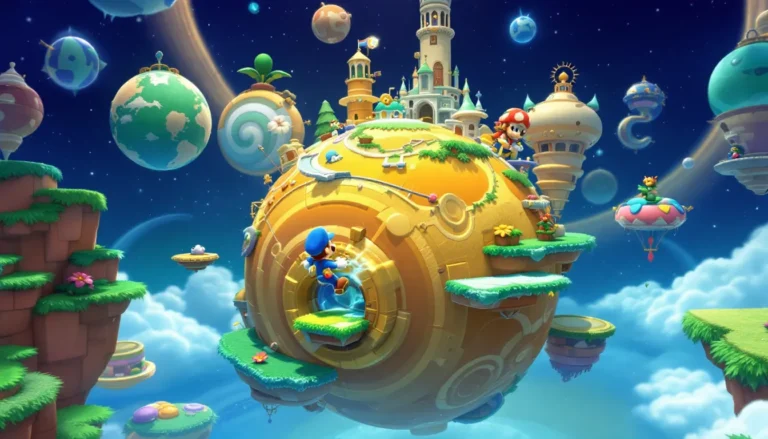
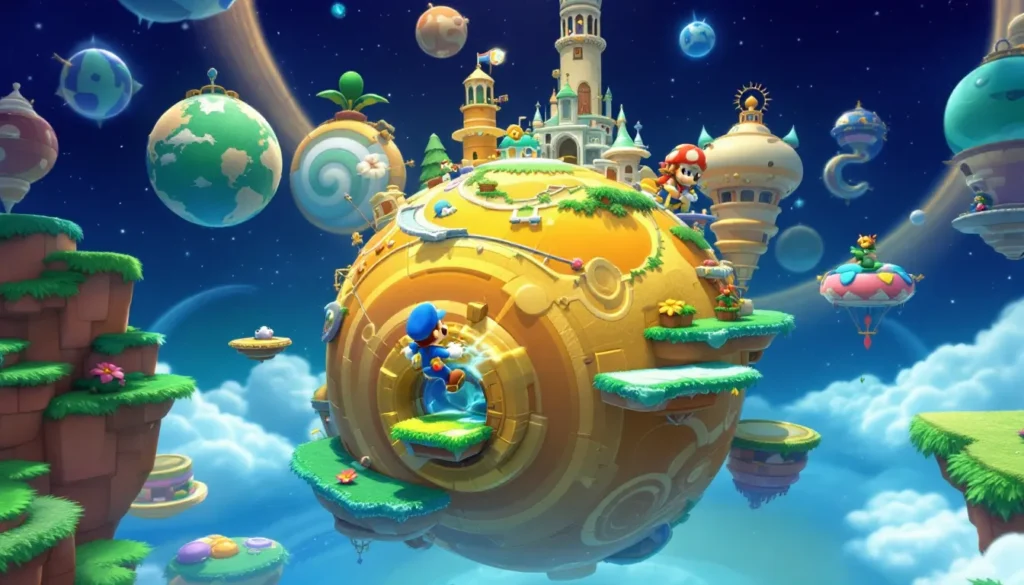
Instead of falling down when you jump, Mario orbits around spherical planets and gravitationally complex worlds. You’ll walk upside-down on floating asteroids, navigate ring-shaped structures, and swing from branch to branch on gravity-shifting stages. The core objective remains straightforward: collect Power Stars by completing levels, defeating bosses, and solving puzzles. But the path to those stars is unlike anything else in the Mario catalog.
The game spans two main campaigns. The first focuses on collecting stars to restore power to your ship and chase Bowser across the galaxy. The second campaign ramps up the difficulty and adds new challenges for players who want to fully complete the game. Between these modes, you’re looking at anywhere from 15 to 30+ hours depending on whether you’re chasing 100% completion.
What makes Galaxy special is its relentless creativity. Nearly every planet introduces a new mechanic or gravitational twist, you won’t encounter the same gameplay loop twice across the entire adventure. This variety keeps the pacing tight and ensures that even in a long campaign, boredom never sets in.
Game Overview And Features On Switch
The Nintendo Switch version of Super Mario Galaxy is a faithful port that respects the original while adapting it intelligently for Nintendo’s hybrid hardware. The game launched in September 2022 as part of a special release window, and it’s remained one of the strongest 3D platformers on the system.
Gravity-Defying Gameplay Mechanics
Gravity isn’t just a gimmick in Galaxy, it’s the foundation of every level design decision. When Mario stands on a spherical planet, “down” always points toward the center. This means you can walk all the way around a small planet and end up upside-down without any disorientation effects. The game trusts players to understand the mechanic instantly, and it pays off with incredibly clever puzzle design.
You’ll encounter planets shaped like hourglasses, donuts, and abstract geometric forms. Some rotate: others shift gravity in specific directions. Boss battles frequently exploit gravity mechanics, you’re not just dodging attacks: you’re using the environment’s gravitational properties to find openings. Late-game stages introduce Flip Switches that toggle entire sections of gravity, creating mind-bending platforming sequences that demand precision and spatial awareness.
Power-ups like the Bee Suit let you climb vertical walls, while the Boo Suit lets you float and pass through obstacles. The Rainbow Star temporarily makes Mario invincible and grants enhanced speed. These tools are distributed thoughtfully, you never feel like you’re stuck with the wrong power-up for the situation.
Motion Controls And Handheld Mode
The original Galaxy games relied heavily on Wii Remote motion controls, and the Switch version had to adapt without losing that physical interaction. Here’s how it works:
In Docked Mode, the game supports both traditional controller input and motion controls via the Joy-Cons. Using motion, you can shake the controller to perform a Spin Attack, which is critical for some platforming sequences and essential for knocking out certain enemies. Many players find the motion implementation smooth and responsive, it never feels like a compromise.
In Handheld Mode, motion controls are still available but feel less natural since the Switch tablet is smaller. Most players switch to button input in portable play, pressing Y instead of shaking. Both work fine, but handheld play skews toward traditional controls. The button mapping is intuitive: standard platforming uses the stick and jump button, while the right stick controls the camera.
Pro Tip: If you primarily play in handheld mode and find motion controls awkward, the button-only control scheme is completely viable. The game never forces you into motion-only challenges, so you’re not at a disadvantage.
Graphics And Performance On Switch
Galaxy on Switch isn’t a graphical overhaul, it’s a competent port of a Wii game that holds up surprisingly well on modern hardware. The art style is timeless. Colorful planets, charming character models, and vibrant visual effects create a world that feels inviting rather than technically impressive. Resolution runs at 1080p docked and 720p handheld, which is adequate but not cutting-edge. Frame rate holds steady at 60 FPS during gameplay, which is crucial for tight platforming controls.
Loading times are minimal thanks to the Switch’s SSD, and the game feels snappy overall. Pop-in is occasional but not distracting. If you’ve played the Wii version, the Switch version is a cleaner, crisper experience without major visual upgrades. If you’re coming fresh, the presentation is charming and serves the level design perfectly, nothing here gets in the way of the gameplay.
The art direction does the heavy lifting. Each world has a distinct visual identity, from the serene Gold Leaf Galaxy with its autumn-inspired aesthetics to the chaotic Honeyclimb Galaxy where everything defies expectations. Sound design is equally strong: the orchestral soundtrack enhances the sense of cosmic adventure without overpowering gameplay audio cues.
Getting Started: Tips For New Players
If you’re jumping into Galaxy for the first time, the learning curve is gentle but the skill ceiling is high. The early game teaches mechanics gradually, so you won’t feel overwhelmed.
Essential Controls And Camera Management
The first thing to master is camera control. Unlike linear platformers where the camera follows a fixed path, Galaxy’s camera is free-floating around the planet you’re on. You move Mario with the left stick and adjust the camera with the right stick. This dual control takes 10-15 minutes to internalize, but it becomes second nature quickly.
Camera Tips:
- Use the right stick frequently. Don’t let Mario move off-screen: reposition the camera constantly.
- Before jumping, adjust your camera so you can see the landing zone clearly.
- In tight platforming sections, pull the camera back for better spatial awareness.
- If you feel disoriented on a spherical planet, tilt the camera to see the full layout.
Jump timing is everything. Unlike some Mario games with generous jump windows, Galaxy rewards precision. You need to tap the jump button at the exact right moment to land tight platforms. Early levels are forgiving: later stages demand frame-perfect input. The Spin Attack (shake motion or press Y) serves multiple purposes: breaking certain objects, defeating weak enemies, and launching Mario further during jumps.
The Run Button (hold down ZR or ZL) is essential. You’re constantly sprinting in Galaxy, and holding the button becomes muscle memory. Release it only when precision is required.
Collecting Power Stars And Secret Areas
Power Stars are the currency of progression. Each galaxy contains multiple stars accessible through different objectives. A single galaxy might have one star for completing the main path, another for defeating all enemies, and a third hidden in a secret area. This design encourages replayability, revisit galaxies to hunt for stars you missed.
Star Hunting Strategy:
- Don’t rush through levels. Explore side paths and look for suspicious areas, walls that seem breakable, gaps that seem jumpable, or environmental clues.
- Sling Stars (glowing purple spheres) launch Mario across gaps. If you see one, it usually leads somewhere important.
- Some stars require specific power-ups. If a section seems impossible, return later with the right suit equipped.
- Comet Stars appear during specific cosmic events. The game tells you when and where they spawn: prioritize these during their availability window.
Secret areas are hidden everywhere. Look for color variations in the environment, a differently shaded rock, a patch of grass that stands out. These often hide Launch Stars that lead to bonus planets or shortcuts. Breaking destructible objects sometimes reveals coins and extra lives, so thorough exploration is rewarded.
Early game galaxies (Gold Leaf, Sand Spiral) are tutorial-heavy and introduce concepts you’ll use throughout. Don’t skip these, understanding the fundamentals makes everything that follows manageable. If you hit a wall in a later galaxy, you likely need to improve timing, master a new mechanic, or revisit an earlier concept you might have glazed over.
Advanced Strategies And Secret Unlockables
Once you’ve collected the bulk of the accessible stars, the game shifts into a higher gear. Advanced play revolves around precision, hidden content, and mastery of mechanics that initially seemed simple.
Finding Hidden Planets And Comet Stars
Beyond the main level progression, Galaxy hides entire planets and galaxies that you can only access by meeting specific conditions. Some are tied to Comet Star spawns, others require collecting stars in a particular order, and a few are simply tucked into optional pathways.
The Gold Leaf Galaxy contains a secret path accessible only after collecting a certain number of stars. The Sea Slide Galaxy has an entire bonus planet hidden behind seemingly empty space. These discoveries feel like rewards for thorough exploration rather than arbitrary collectibles.
Comet Stars are time-limited challenges that appear when a comet passes through a galaxy. These aren’t optional, collecting them is mandatory for 100% completion. Each comet star introduces a fresh challenge: a gravity-flipped version of a level, a timed speedrun, or an enemy gauntlet. Comet stars are genuinely difficult: expect to replay sections multiple times to master them.
Pro Strategy: Keep a star checklist as you progress. After beating the main campaign, cross-reference your collected stars against online guides to identify gaps. Comet stars and secret planets are the primary sources of missing stars.
Some planets are one-time visits unless you replay the galaxy, so don’t assume you’ll return later. If you see an area that looks unexplored, tag it immediately or risk forgetting about it.
Mastering Difficult Bosses And Challenges
Galaxy’s boss design is exceptional. Each boss teaches you something about the game’s mechanics while being genuinely challenging. Bowser is the main antagonist, but you’ll face him multiple times with increasing difficulty. Each encounter introduces new phases and gravitational twists.
Boss Strategy Framework:
- Watch the first phase without attacking. Understand the boss’s attack pattern and identify when openings appear.
- Most bosses have a specific weak point, usually on their back or a newly exposed section after they attack.
- The Spin Attack works on almost every boss, but timing is crucial. Spin only after dodging their attack: committing to a spin at the wrong time leaves you vulnerable.
- Gravity affects boss battles. Some bosses exploit environmental gravity shifts: stay aware of your position relative to the planet’s center.
Late-game challenges like the Purple Coins hunt and the Daredevil Comet are brutal. These require near-perfect execution. Daredevil comets force you through a gauntlet with only one hit point, a single touch from an enemy ends the attempt. These aren’t for everyone, but completing them is incredibly satisfying.
If you’re stuck on a boss, try these approaches: take a break and return with fresh eyes, adjust your camera angles for better visibility, or watch a video to understand the attack pattern. Boss difficulty is rarely unfair: usually, it’s about reading the pattern and executing precisely.
Co-Op Multiplayer Mode Guide
Super Mario Galaxy features a cooperative multiplayer mode that lets a second player assist Mario’s adventure. This isn’t a fully playable second character, instead, Player 2 controls a Luma that can collect coins, stun enemies, and grab items.
How Co-Op Works:
Player 1 controls Mario entirely: Player 2 uses their Joy-Con to aim a cursor and press a button to make their Luma grab objects or attack enemies. This dual-player dynamic is genuinely cooperative. The second player isn’t just watching, they’re actively managing the battlefield by disabling threats and collecting resources.
Co-Op Strategy:
- Coordinate grab timing. If Mario is in danger from multiple enemies, the Luma should prioritize the closest threat.
- The Luma can grab coins that Mario would otherwise miss. This is valuable for collecting extra lives or power star counts.
- Some puzzles require Player 2 to grab objects while Player 1 navigates platforming sections. Communication is key.
- The second player needs quick reflexes. Timing grabs and disables requires precision similar to Mario’s jump timing.
Co-op mode is designed so that a second player can join or drop out at any time without breaking progress. This flexibility makes it great for casual play sessions with friends or family members who might not be experienced gamers.
Competitive players often skip co-op entirely, but for casual completionists, having a second player accelerates star collection and makes some of the more tedious sequences more engaging. The mode peaks in challenge around the mid-game where enemy density is highest.
Comparison: Switch Version Vs Original Wii Release
Super Mario Galaxy on Nintendo Switch is fundamentally the same game released on the Wii in 2007, but the Switch version benefits from over 15 years of technical refinement and platform advantages.
Performance Gains:
The original Wii version ran at 30 FPS with lower resolution textures. The Switch version locks at 60 FPS in handheld and docked modes, which makes platforming tighter and more responsive. Camera control feels snappier, and environmental pop-in is minimized. These aren’t revolutionary changes, but they meaningfully improve the experience.
Control Adaptations:
Wii Motion Plus was mandatory for the original Galaxy games, most interactions required shaking the remote. The Switch version maintains motion controls but makes them optional. You can complete the entire game with traditional button input, which is huge for handheld players or anyone with motion control fatigue. This flexibility is the biggest quality-of-life improvement the Switch version offers.
Visual Consistency:
The Wii version suffered from occasional visual inconsistencies and muddy textures on composite cables. Playing on modern displays reveals how much the art direction carried the game. The Switch version doesn’t upscale textures or add new models: it simply presents the original assets more cleanly. On a 4K display docked, the improvement is noticeable.
Content Parity:
The Switch version includes all content from both the Wii original and the sequel (Galaxy 2). This is the complete Mario Galaxy experience, 120+ Power Stars, multiple galaxies, and all challenge modes. If you played Galaxy on Wii, you won’t find new levels here, but the refined controls and performance make replaying worthwhile.
Portability:
This is the decisive factor for most Switch owners. Playing Galaxy in handheld mode while lying on a couch is genuinely convenient. The original Wii version demanded standing or sitting upright with a controller: Galaxy on Switch offers flexibility.
Verdict: If you’ve already 100% completed Galaxy on Wii and don’t value portability, you’re not missing anything. For new players or anyone who values the option to play anywhere, the Switch version is the definitive way to experience the game in 2026. GameSpot for side-by-side video comparisons if you want to see the differences in motion.
Conclusion
Super Mario Galaxy on Nintendo Switch is a masterclass in 3D platformer design that remains engaging nearly two decades after its original release. The game’s gravity mechanics feel as fresh today as they did in 2007, and the Switch version’s performance improvements and control flexibility make it the most accessible version ever made.
Whether you’re a completionist hunting for every Power Star, a casual player enjoying one galaxy at a time, or someone experiencing Mario’s galactic adventure for the first time, there’s something here for everyone. The learning curve is gentle but the depth is substantial, you can enjoy the game at whatever level challenges you.
The core experience hasn’t changed, and it doesn’t need to. Galaxy’s level design, art direction, and mechanical creativity speak for themselves. With 120+ stars to collect, multiple difficulty tiers, and cooperative play, you’re looking at dozens of hours of quality platforming. For Nintendo Switch owners who haven’t experienced Galaxy, it’s an essential title. For Wii veterans, the refined controls and portability justify revisiting this classic.