

Table of Contents
ToggleBlack Friday is gaming’s biggest shopping event, and the Nintendo Switch OLED is always near the top of every deal hunter’s list. If you’ve been waiting for the perfect moment to grab this hybrid console, whether you’re upgrading from the standard model or jumping into the Nintendo ecosystem for the first time, 2025’s Black Friday is shaping up to be your window. Unlike past years, this shopping season brings tighter competition between retailers, deeper bundle options, and accessories that are actually worth bundling. But knowing when to buy, where to find the best prices, and what deals are legit (versus marketing noise) separates smart shoppers from ones who miss out. This guide breaks down everything you need to know to score the Nintendo Switch OLED at its best price this Black Friday.
Key Takeaways
- Nintendo Switch OLED Black Friday deals typically range from $299–$329 for console-only offers and $349–$449 for game or accessory bundles, making it the best time of year to buy.
- The OLED model’s 7-inch display offers superior screen quality with vibrant colors and perfect blacks compared to the standard Switch, making it ideal for handheld gaming enthusiasts who play 10+ hours weekly.
- Console-only deals sell out within 2–6 hours on Black Friday, so successful shoppers should prepare payment methods in advance, set price alerts by early November, and buy immediately when spotting deals under $320.
- Game bundles like Console + Mario Kart 8 Deluxe + Case offer better value than console-only purchases, with retailers like Target and Walmart providing the most variety in bundle options.
- Monitor Best Buy, Target, Walmart, and Amazon simultaneously using price-matching strategies and loyalty programs (RedCard’s 5% discount or My Best Buy+ rewards) to maximize savings on your Nintendo Switch OLED purchase.
What Is The Nintendo Switch OLED?
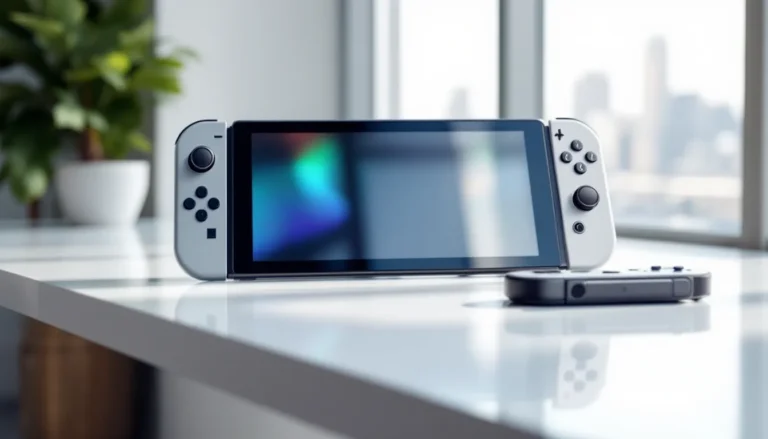
The Nintendo Switch OLED is Nintendo’s premium handheld-home hybrid console, released in October 2021. It’s the iteration that matters if you care about screen quality and have cash to spend. The centerpiece is its 7-inch OLED display, a massive upgrade from the standard Switch’s 6.2-inch LCD panel. Colors pop with actual blacks (OLED pixels emit their own light), contrast ratios are deeper, and if you’re playing a visually rich game like Zelda: Tears of the Kingdom, the difference is immediately noticeable.
The hardware under the hood is identical to the standard Switch: same NVIDIA Tegra processor, same 32GB internal storage, same Joy-Con controllers. The OLED model’s real selling points are the bigger, better screen and a few quality-of-life tweaks, a slightly improved kickstand, better speakers, and a glossy back that some love and others find too reflective.
Portability hasn’t changed: it’s still a 9.4-inch-wide device that slips into a bag or backpack. Dock it at home for TV play, detach the Joy-Cons for tabletop or handheld mode, or play entirely in handheld. For gamers who care about display quality and spend significant time in handheld mode, the OLED is the definitive Switch experience. For those content with the standard model, it’s a luxury upgrade rather than a necessity. That distinction matters when considering whether a Black Friday deal is worth your money.
Why Black Friday Is The Best Time To Buy
Black Friday isn’t just another shopping day, it’s when Nintendo Switch prices hit their lowest point of the year. Retailers treat the console as a loss leader to drive foot traffic and bundle sales, meaning discounts compound in ways you won’t see in July or even during holiday season proper.
Historical Pricing Trends
The Nintendo Switch OLED launched at $349.99 and has maintained that MSRP for years. Discounts, when they happen, are modest but meaningful. During Black Friday 2023 and 2024, the console dropped to $299–$319 at major retailers like Best Buy, Target, and Walmart. That’s a $30–$50 cut, not massive in percentage terms, but it’s the floor. The real value, historically, comes from bundles. Retailers pair the OLED console with popular games (often Mario Kart 8 Deluxe or Switch Sports) or accessory packs, bringing the effective discount closer to $80–$100 when you factor in what you’d pay separately.
Steam sales and PlayStation Direct sales may offer deeper percentage discounts, but Nintendo’s hardware rarely follows that pattern. The Switch ecosystem stays relatively sticky on pricing because demand outpaces supply in many regions, even years into the console’s life cycle.
Expected Discount Range For 2025
Based on 2024’s patterns and early retailer signaling, expect the Nintendo Switch OLED to land between $299 and $329 for console-only deals, roughly a $20–$50 discount. That’s conservative compared to other hardware, but it’s consistent with Nintendo’s pricing strategy.
Where you’ll see real savings is in game bundles. Retailers are likely to offer the console bundled with one or two games at a slight discount, effectively saving you $20–$40 on software alone. Accessory bundles (console + case + screen protector + game) could hit $349–$399, saving 15–20% compared to buying everything separately.
One wild card: rumors suggest Nintendo might announce a successor to the Switch in 2025. If that happens before Black Friday, discounts could get aggressive as retailers clear inventory. But, that’s speculation. For planning purposes, assume $299–$349 for the console and $399–$449 for quality bundles is the realistic range.
Nintendo Switch OLED Black Friday Deals To Watch For
Knowing what deals typically appear helps you spot the good ones versus filler when Black Friday ads drop.
Console-Only Discounts
Console-only deals are rare and sell fast. In 2024, Best Buy and Amazon had brief windows offering the Switch OLED for $299. These usually last 2–6 hours before stock depletes, and they’re almost always online-exclusive or limited in-store quantities.
If you see a console-only deal for $299–$319, grab it immediately, these are the baseline good deals. Anything below $299 is either a mistake or part of a larger bundle you should inspect closely. Watch for fine print about warranty or included accessories: occasionally a $299 deal excludes the dock or comes missing a Joy-Con.
Game Bundle Offers
Game bundles are where real value hides. Expect:
- Console + Mario Kart 8 Deluxe + Case: ~$349–$379. Mario Kart is timeless, and a case protects your investment. This is a strong entry-level bundle.
- Console + Switch Sports + Case: ~$349–$379. Less compelling than Mario Kart (Sports is more casual), but sometimes cheaper.
- Console + Zelda: Tears of the Kingdom: ~$399–$429. This is premium pricing, but Tears of the Kingdom costs $70 separately, so the effective console discount is significant.
- Console + Nintendo Switch Sports + Mario Kart 8 Deluxe: ~$399–$449. Rare but occasionally appears. Best value for casual households.
Indie games or older titles (like Splatoon 3) sometimes bundle at lower tiers, but they offer less perceived value to buyers. Target and Walmart typically lead on game bundle variety. Amazon and Best Buy favor console + accessory combos.
Where To Find The Best Nintendo Switch OLED Deals
Deals vary by retailer, and knowing which platform to watch saves time and money.
Major Retailers
Best Buy typically has the sharpest console pricing and exclusive bundles. They often price-match and run early Black Friday sales for My Best Buy+ members (starts mid-November). In-store and online deals sometimes differ: online is usually more aggressive.
Target excels at game bundles and accessories. RedCard holders get 5% off everything, which stacks with Black Friday discounts. Their inventory management is solid, so stock tends to last longer than Best Buy’s.
Walmart runs aggressive bundle pricing, especially on less popular game combos. Walmart+ members get early access, sometimes starting Wednesday before Thanksgiving. The downside: Walmart’s customer service and return policies are less forgiving than competitors.
GameStop is hit-or-miss. They occasionally bundle the console with in-store credit or trade-in bonuses, but standalone pricing is rarely competitive. Check their deals only after confirming competitors’ offers.
Online Shopping Platforms
Amazon often matches Best Buy’s console pricing and ships faster than anyone if you have Prime. Prime Day (July) offers better discounts, but Black Friday bundles are solid. Watch for fulfilled-by-Amazon (FBA) listings versus third-party sellers, FBA guarantees return windows and warranty support.
Nintendo eShop rarely discounts the hardware itself but occasionally bundles digital game codes. Not worth prioritizing for console deals but useful for accompanying software purchases.
Best approach: Check prices simultaneously across Best Buy, Target, Walmart, and Amazon using browser tabs. Set price alerts on CamelCamelCamel (for Amazon) or Honey starting early November. Retailers often price-match, so grab the best offer and move fast, Switch OLED stock evaporates during Black Friday’s first 24–48 hours.
Use Digital Trends and IGN for live Black Friday deal tracking and verification. Aggregator sites miss regional deals and inventory changes.
Nintendo Switch OLED vs. Standard Switch: Which Should You Buy?
The standard Switch (LCD model, $299 MSRP) is the budget alternative, and it might be the smarter Black Friday pickup depending on your priorities.
OLED’s advantages:
- Stunning 7-inch OLED display with perfect blacks and vibrant colors
- Better handheld experience for 30+ hours of gaming per week
- Improved speakers (noticeably louder)
- Better kickstand (though not perfect)
- Premium feel and resale value
Standard Switch’s advantages:
- Usually $50–$100 cheaper at retail or Black Friday
- Matte back reduces glare (OLED’s glossy finish reflects light)
- Lighter weight (negligibly, but it matters over hours)
- Proven hardware (fewer reports of drift issues early on)
- Docked play looks identical to OLED on a TV
The deciding factor: how much handheld time matters. If you dock the console 80% of the time, the standard Switch is a no-brainer savings. The TV output is identical. If you game 10+ hours weekly in handheld mode, the OLED’s display justifies the extra cost.
For competitive games like Splatoon 3 or VALORANT ports (if released), the standard Switch performs identically. For story-driven games like Zelda: Tears of the Kingdom or Xenoblade Chronicles, the OLED’s visual fidelity shines.
Black Friday pricing rarely discounts the standard Switch aggressively since it’s already the budget model. You might see $20–$30 off, but the OLED often becomes more attractive at $299–$319 versus the standard at $269–$279. Do the math for your situation. If the gap narrows to $30–$50 during Black Friday, OLED becomes the better long-term investment.
Money-Saving Tips For Black Friday Gaming Purchases
Smart shopping beats deal-hunting speed every time.
Price Matching And Guarantee Strategies
Most major retailers price-match within 7–14 days of purchase. If you buy on Black Friday and a competitor drops prices further by the following Tuesday, request a price adjustment. Best Buy’s policy is especially generous (matches for 15 days). Email a screenshot of the competitor’s price, no hassle required.
Combine this with loyalty programs:
- Best Buy My Best Buy+: Annual fee ($200) earns 2% rewards on all purchases. On a $350 bundle, that’s $7 back. Breaks even after 10 transactions.
- Target RedCard: No annual fee. 5% off everything, including Black Friday deals. Stacks with promotions. Free shipping on orders over $35.
- Walmart+: $98 annually. Early Black Friday access (starts Wednesday) and free shipping. Worth it only if you shop there regularly.
For one-time Black Friday shoppers, RedCard is the easiest play, just apply for the free version at checkout.
Timing Your Purchase
Black Friday sales technically run Thursday–Sunday (Thanksgiving through Cyber Monday), but actual deals follow two waves:
- Wave 1 (Thursday–Friday morning): Console-only and premium bundle pricing. Inventory depletes fastest here. If you see a console-only deal, buy immediately.
- Wave 2 (Friday afternoon–Cyber Monday): Clearance items, slightly worse bundles, and accessories. Better stock availability. Useful if you missed Wave 1.
Console deals rarely extend beyond Sunday. Game and accessory sales occasionally run into the following week, but Black Friday proper is your window. Plan to shop Thursday evening or Friday morning for the best console pricing. Waiting until Monday hoping for better deals backfires, inventory won’t last.
What To Prepare Before Black Friday
Preparation beats impulse buying every time.
Budget Planning
Decide your ceiling before Black Friday ads drop. A typical well-informed purchase looks like:
- Bare minimum: Console only, $299–$319.
- Balanced: Console + one game + case, $349–$399.
- Complete setup: Console + two games + Pro Controller + screen protector + case, $449–$529.
Stick to your tier. Retailers use FOMO and fake urgency to push bundled purchases you don’t need. A console + three games isn’t better than a console + one game you’ll actually play. Minecraft Game for Nintendo is a solid Black Friday pairing if you want creative gameplay: Pokemon Go Nintendo Switch: is less universally appealing. Choose games matching your actual play style.
Wishlist And Stock Preparation
Start a wishlist by early November. Track:
- Preferred console color (White OLED is standard: Black OLED is rarer and sometimes pricier).
- Must-have games (Mario Kart, Zelda, specific indies).
- Accessories you genuinely need (case, screen protector, second set of Joy-Cons).
- Preferred retailers based on return policies and shipping speed.
Set price alerts on CamelCamelCamel (Amazon), Honey (browser extension), or RetailMeNot starting in October. Get notifications 24 hours before Black Friday goes live. Monitor retailer websites daily starting early November, some announce early access sales and bundle details weeks in advance.
Pre-authorize your payment method. Accounts with active credit cards and saved addresses checkout faster. During Black Friday chaos, seconds matter. Check your internet connection the night before, hardwired is faster than Wi-Fi for mobile carts. If you’re shopping on mobile, test the retailer’s app beforehand. App checkouts often process faster than browser versions.
Common Mistakes To Avoid
Black Friday brings predictable pitfalls. Avoid these:
Buying bundles with games you won’t play. “Console + 3 games for $399” looks like value until you realize you only want one of those games. You just paid for $50–$70 in software you’ll delete. Smaller bundles with fewer, higher-quality games hit better.
Ignoring return windows. Black Friday purchases often have 30-day returns versus the typical 14-day window. Verify your retailer’s policy before buying. If you get buyer’s remorse or a hardware issue surfaces, you want maximum flexibility.
Skipping warranty/protection plans. Nintendo Switch OLED hardware is reliable, but Joy-Con drift is documented. A two-year accidental damage protection plan ($30–$50) is optional but worth considering if you game 20+ hours weekly. Check what’s included, some plans exclude drift specifically.
Buying from third-party sellers. Amazon Marketplace occasionally lists “new” Switch units from unverified sellers at discount prices. These often ship open-box or refurbished without disclosure. Stick to FBA (fulfilled by Amazon) or major retailers.
Overlooking earlier sales. Some retailers start Black Friday deals Monday evening. If you assume Friday is the only day, you’ll miss earlier discounts. Start monitoring Thursday morning.
Sleeping on Cyber Monday. Console stock often restocks between Black Friday and Cyber Monday. If you struck out Friday, check Monday morning before writing off the season.
Not confirming stock before checkout. “Limited quantities available” isn’t empty rhetoric during Black Friday. Check stock counts on the retailer’s website. If it says “fewer than 5 left,” that’s real. Add to cart immediately and complete checkout, don’t browse around.
Use GamesRadar+ for curated Black Friday roundups and live inventory tracking. Their deals experts flag common retailer tricks and verify legitimacy before publication.
Conclusion
Black Friday 2025 is your best window to grab the Nintendo Switch OLED at a real discount. You’re looking at console pricing between $299–$329, bundles in the $349–$449 range, and accessory discounts that actually matter.
Success comes from two things: preparation and speed. Know your budget, decide which bundle (if any) adds real value, and have your payment method ready before sales go live. Watch Best Buy, Target, Walmart, and Amazon simultaneously. The moment you spot a console-only deal under $320 or a bundle matching your wishlist, buy. Hesitation costs you inventory.
If the Nintendo Switch OLED doesn’t fit your budget or handheld priorities, the standard Switch at $269–$299 is still solid. And if you already own a Switch, don’t feel pressure to upgrade: the OLED’s advantages matter most to dedicated handheld players. Black Friday deals aren’t licenses to overspend, they’re opportunities to get exactly what you wanted at a better price.
Check out Nintendo Switch Code Secrets: Unlock Exclusive Content and Discounts Today – Questtiny and Nintendo Switch V-Bucks Gift Card: Unlock Epic Fortnite Skins & Savings Today – Questtiny for complementary guides on maximizing your Switch purchase after Black Friday. Plan smart, shop fast, and enjoy your new console.